
Author Archives
from Sanjit Singh Paul

Podcast – Handling Financial Emergencies
We think differently when planning finances for a company (work-life) than when we do it for ourselves (personal life). Understand what goes into thinking about financial emergencies and a bit more, in this conversation between Sanjit and Tushar. Watch below...
https://youtu.be/H05pN4EjVt8?si=av3MuSagFBeRBNal
Watch on Youtube
Introduction
Video Transcript: Financial success is often associated with education, career growth, and smart investments. ...
Podcast – Quantamental Investing
My investing journey has shaped my investment style. A few bits on how we use Quantamental Investing to build Value, Growth, and Sentiment portfolios at Modulor Capital. Listen below.
https://www.youtube.com/watch?v=wjqdKm04npQ
Watch on Youtube
Listen on Spotify
Video Transcript:
Host: Welcome to the Super Investors Podcast, where we connect with some of the most successful investors and wealth creators.
In our inaugural episode, we are delighted to host Sanjit Singh, Managing ...

How to invest like a pro
The critical reason that professional investors make more money than most other investors is that they engage with the financial markets (of all sorts) full-time. This does not imply they are more intelligent than other non-professional investors but does imply that they invest with clear-cut agendas. They design specific strategies to meet these agendas and ...

How to invest if you are a newbie
As an adviser, we get to interact with clients at various stages of investor maturities. While some clients are beginning to build a portfolio, others already have one. In the process of giving clients investment advice, the first part of our job is to unwind their complex portfolios before we build them one which is ...

The Risk-Safety Quadrant of Investing
In a world where individuals and institutions are “required” to invest, minimizing risk and finding safety has become a necessity.
Investors often use Risky and Safe as opposite words when assessing an investment. The two words are antonyms of each other in the English language. However, in the world of finance, they can mean a different ...
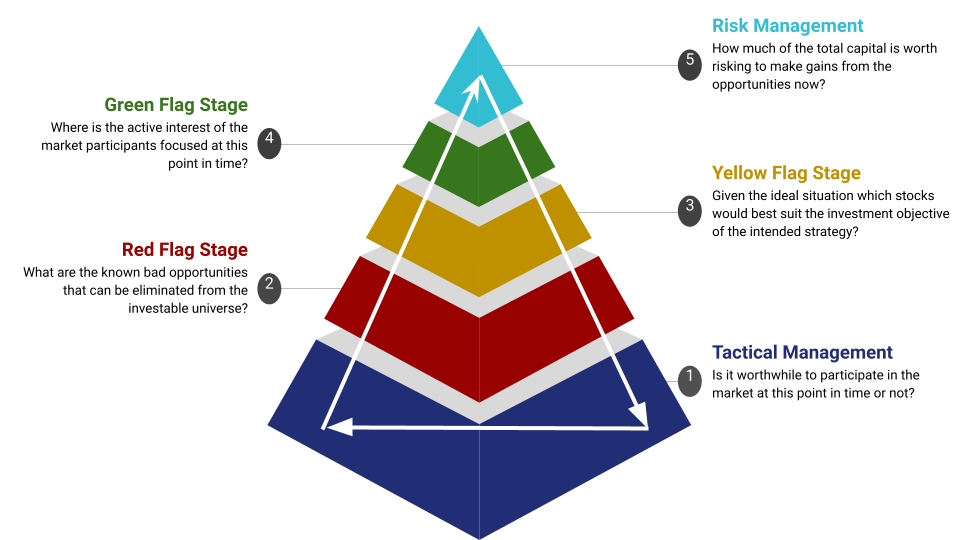
The Quantamental Investing Process – How we build and manage portfolios
The QVGS Framework defines principles at the market, portfolio, and security levels useful for creating and managing portfolios across asset classes and market segments.
Managing portfolios is a continuous endeavor. This requires us to follow a strategy-based approach to generate returns from different sources and be system-driven to manage risk.
At Modulor Capital, we run 3 processes ...

The QVGS Framework – Implementing Quantamental Investing
Every portfolio manager has a different idea about how markets work which makes them follow an investment process that is uniquely suited to how they think. This thinking is an outcome of the experiences of the portfolio manager in the markets, resulting in an infinite number of ways to construct a portfolio. Yet, when constructing ...

PIC — The Satellite Investment Objectives
When individuals and families are able to satisfy their needs of:
being able to cover for immediate-term contingencies — Preservation,
having enough to survive through protracted tough times — Accumulation, and
growing their wealth through the efforts of others — Growth
they look to do more with their money. Satisfaction of needs through Core Investment Objectives leads individuals and families to pursue their desires.
At ...

GAP – The Core Investment Objectives
In the previous article “Quantamental Investment Objectives”, we defined Fundamental Investment Objectives as (i) Funding, (ii) Financing, and (iii) Safe-haven that determines how the money is invested and where it goes.
Alongside, Quantitative Investment Objectives of (a) Risk-free, (b) Inflation, (c) Compounding, (d) Fat-tailed, and (e) Exponential are the shapes of distributions that determine how the returns on the investment and experience of the investor will be when investing this money.
These ...

The Three Bucket Strategy
Modern times need a new approach to specific areas within old relationship structures. One such area that is being challenged by modern times is finances in a relationship.
The Traditional Relationship
In the old world, marriage had clearly defined roles. The traditional “husband” of the marriage worked outside the house and generated money. This out-of-house work was complemented by in-the-house ...