
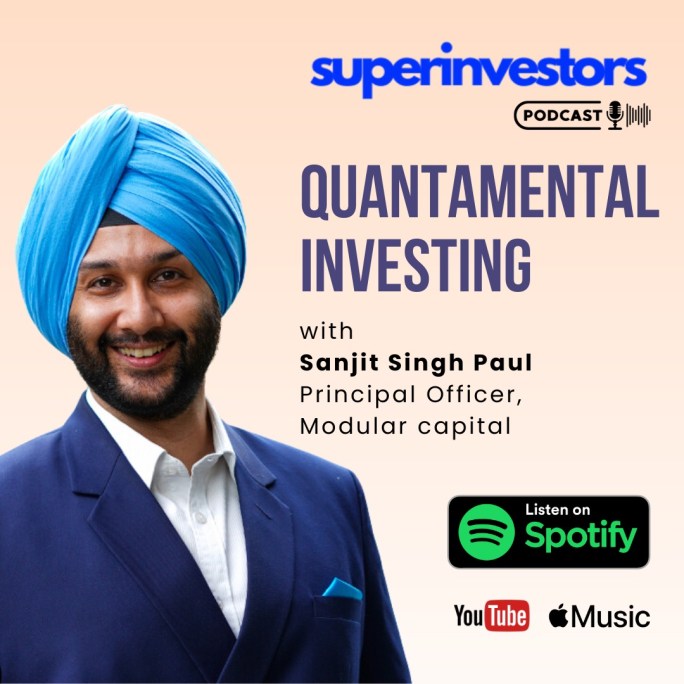
Podcast – Quantamental Investing
My investing journey has shaped my investment style. A few bits on how we use Quantamental Investing to build Value, Growth, and Sentiment portfolios at Modulor Capital. Listen below.
Listen on Spotify
Video Transcript:
Host: Welcome to the Super Investors Podcast, where we connect with some of the most successful investors and wealth creators.
In our inaugural episode, we are delighted to host Sanjit Singh, Managing Partner and Principal Officer at Modulor Capital, a SEBI-registered Investment Adviser.
With nearly two decades of experience in financial markets, Sanjit shares his journey from trader to investor, discusses the evolution of his Quantamental Investing framework, and offers insights into portfolio construction, risk management, and long-term wealth creation.
Sanjit Singh’s Journey into Investing
Host: Before we discuss your investment framework and portfolios, could you tell our listeners a little about yourself and your background?
Sanjit Singh: Certainly. I have been involved in the financial markets since 2006 and have witnessed multiple bull and bear market cycles during this period.
I completed my engineering degree in 2005 and later pursued an MBA from the Indian School of Business (ISB), where I formally studied finance.
Like many young market participants, I started with a strong desire to understand how money is made in the markets. In those days, online trading was not as common as it is today. Most trading activity took place through brokerage terminals, and I spent a significant amount of time observing market movements and learning from experienced traders.
I eventually joined a brokerage firm in Chandigarh, where I gained hands-on exposure to trading derivatives, futures, and options. This practical experience taught me lessons that no textbook could have provided.
One of the defining moments in my early career came during the period leading up to the global financial crisis of 2008. Through technical analysis, I sensed that markets were becoming increasingly vulnerable. Although I lacked the experience and confidence to fully act on that conviction, the subsequent market collapse reinforced an important lesson: markets often provide signals, but recognising them is only half the battle. The real challenge lies in having the discipline and conviction to act on them.
This experience deepened my interest in understanding how markets function and motivated me to study finance more formally.
Discovering Quantitative Investing
During my time at ISB, I had the opportunity to learn from a professor who managed a hedge fund and taught a course on trading systems and strategies.
That course introduced me to the world of quantitative investing. For the first time, I realised that investment decisions could be modelled systematically using data rather than relying solely on intuition or subjective judgement.
I learned how financial information, price behaviour, and market trends could be analysed using structured frameworks and statistical methods. This opened an entirely new perspective on investing.
After completing my MBA, I returned to the brokerage industry and became involved in algorithmic trading. Over the years, I traded across multiple asset classes, including equities, commodities, currencies, futures, and options.
Algorithmic trading was intellectually stimulating, but it was also demanding. Markets required constant attention, and success often depended on remaining glued to screens for extended periods.
Eventually, I began questioning whether active trading was the most efficient path to wealth creation.
The Shift from Trading to Investing
By around 2015, I came to an important realisation.
A skilled trader may generate attractive returns, but a disciplined investor can often achieve comparable long-term outcomes with significantly less complexity and stress.
Trading demands continuous decision-making and constant monitoring. Investing, on the other hand, allows capital to compound over time.
I realised that if investing could be approached systematically—with clearly defined rules, disciplined risk management, and a repeatable process—it could become a more sustainable and scalable approach to building wealth.
This shift in thinking fundamentally changed my career.
Over time, I began combining lessons from technical analysis, quantitative investing, and fundamental research. Rather than treating these disciplines as competing approaches, I viewed them as complementary tools.
That philosophy eventually evolved into what we now call Quantamental Investing—a framework that integrates quantitative, fundamental, and technical analysis into a unified investment process.
Looking back, my career has largely been a process of learning what not to do, refining decision-making frameworks, and continuously improving the process. The outcomes are never fully within our control, but the quality of our process is.